News · Updated · Published · 5 min read
Edmonton Private Tree Bylaw: What Homeowners Need to Know
Edmonton City Council debates a potential private tree bylaw that could change how mature trees are protected on residential property.

Table of Contents
On February 17, 2026, Edmonton City Council debated the future of a potential private tree bylaw. While no final bylaw has been passed, Council signaled continued interest in mechanisms that could better protect mature trees on private property.
This is an evolving situation, and we will continue updating this post as more details become available.
What Happened at Council?
As of the February 17 meeting:
- Council did not pass a final private tree bylaw.
- The discussion focused on whether to move forward with formally drafting one.
- Council voted 8–4 to maintain current infill density rules (allowing up to eight units on mid-block lots).
- Several councillors and the Mayor expressed interest in creating a mechanism—potentially tied to demolition permits—that would require protection or replacement of mature trees.
City Administration has cautioned that a private tree bylaw could be costly and complex to enforce. However, the broader conversation makes one thing clear: tree preservation is now firmly part of Edmonton's housing and planning debate.
Why This Matters: Edmonton's Urban Canopy
Edmonton's urban canopy currently sits at roughly 13%. Mature trees on private property make up more than half of the city's total tree cover.
When redevelopment results in the removal of established trees, the loss is immediate — and replacement trees can take decades to provide the same environmental, aesthetic, and property value benefits.
Preserving mature trees helps:
- Improve air quality and reduce urban heat
- Manage stormwater naturally
- Support biodiversity
- Maintain neighbourhood character and property value
Any future bylaw discussion is ultimately about balancing housing growth with long-term canopy health.
What Might a Private Tree Bylaw Include?
Although nothing has been finalized, other Canadian cities require permits for removing trees above a certain trunk diameter (often 30–40 cm).
These systems typically involve:
- An arborist assessment
- A removal permit
- Replacement planting or compensation
It is not yet clear whether Edmonton would adopt a diameter-based system, link tree review to demolition permits, or introduce another structure entirely.
What This Means for Homeowners (Right Now)
At this time:
- There is no new private tree bylaw in effect.
- Current rules for private property remain unchanged.
However, the direction of the conversation suggests that additional protections could emerge in the coming months.
If you are planning a renovation, infill build, or tree removal, this is a good moment to pause and consider:
- Whether the tree is healthy and structurally sound
- Whether preservation options exist
- How removal could impact long-term property value and neighbourhood canopy
A professional Tree Health Assessment can help you make an informed decision before any irreversible action is taken.
For Developers & Builders: Planning Ahead
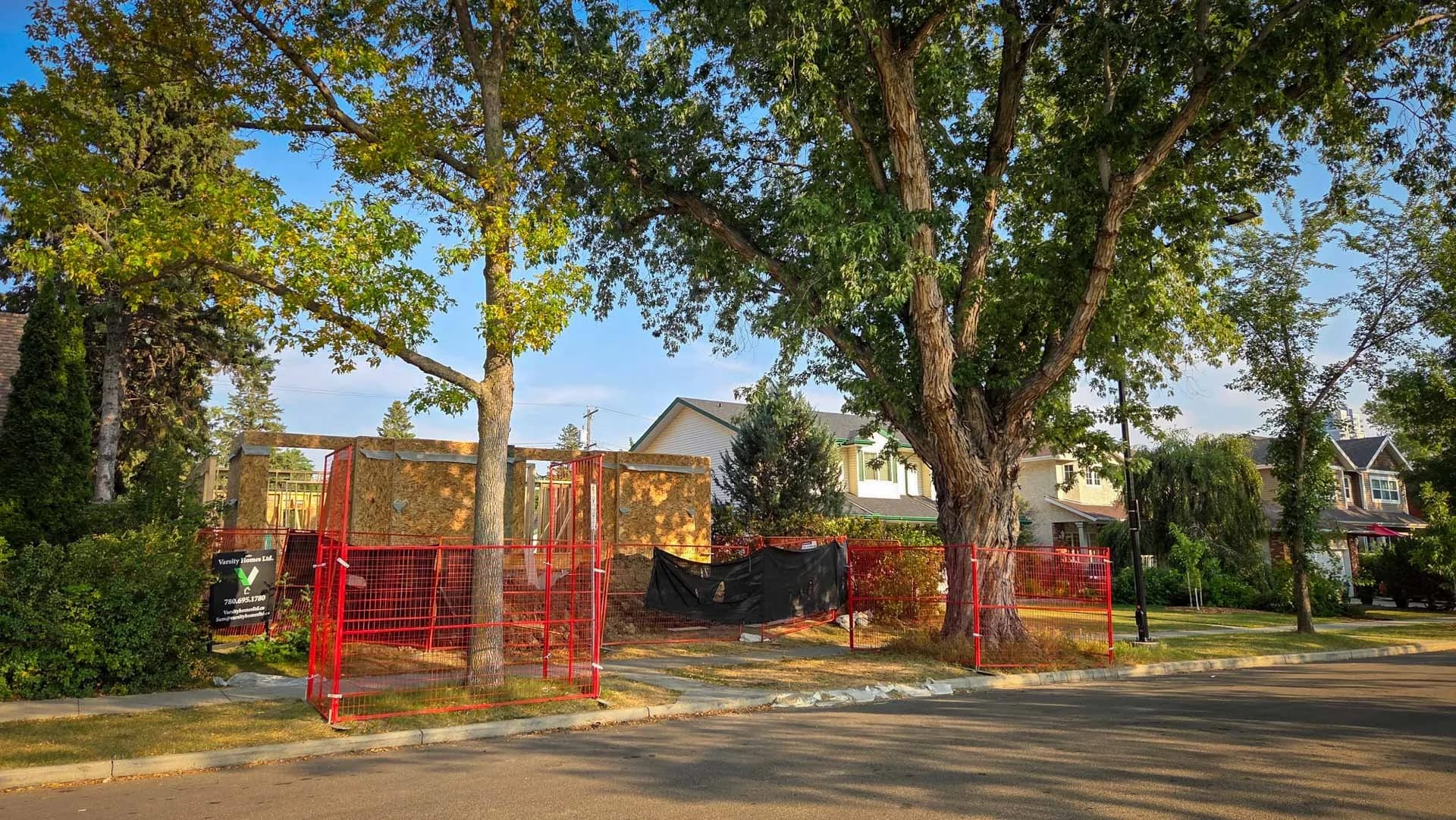
Tree protection fencing installed around mature trees during an Edmonton infill redevelopment project to preserve root zones and canopy health.
For infill and redevelopment projects, early planning is critical.
Tree preservation does not have to conflict with development. In many cases, thoughtful site design and proper root zone protection can allow mature trees to remain while construction moves forward.
We've previously written about how thoughtful infill housing and tree preservation can work together in Edmonton.
Infill Housing & Tree Preservation in Edmonton
Our Tree Protection & Preservation Plans are designed to help projects move smoothly while safeguarding valuable trees.
Proactive planning reduces risk, avoids potential future compliance issues, and demonstrates environmental responsibility to the community.
What Happens Next?
The private tree bylaw remains a motion for future work. If Council directs administration to draft a bylaw, the process would likely include:
- Policy development
- Public consultation
- A future public hearing (potentially in Spring 2026)
We will continue monitoring developments and update this article as new information becomes available.
Our Perspective: Preservation First
At City Tree Service, our approach has always been preservation-first.
Tree removal should be a last resort — undertaken when safety, disease, or structural failure makes it necessary.
Many trees that appear problematic can often be preserved through:
- Strategic pruning
- Structural support
- Soil management and root care
- Risk assessment and mitigation
By prioritizing preservation, we help strengthen Edmonton's neighbourhood canopy one property at a time.
If you're unsure about a tree on your property — or want clarity before any future bylaw changes take effect — we're here to help.
Frequently Asked Questions: Edmonton Private Tree Bylaw
Do I currently need a permit to remove a tree on private property in Edmonton?
No. As of now, there is no private tree bylaw requiring a permit for removing trees on private property. Existing regulations primarily apply to public (city-owned) trees.
What size tree might require a permit if a bylaw is introduced?
In other Canadian cities, private tree bylaws often apply to trees above a certain trunk diameter — commonly around 30–40 cm measured at chest height. Edmonton has not confirmed whether a similar threshold would be used.
When could a private tree bylaw take effect?
If Council formally directs administration to draft a bylaw, the process would include policy development and public consultation. A final bylaw, if approved, would likely not take effect until later in 2026.
Should I remove a tree now before rules change?
Rushing removal is rarely advisable. Mature trees provide significant long-term value to your property and neighbourhood. A professional Tree Health Assessment can help determine whether preservation, pruning, or risk mitigation is a better option than removal.
Does Edmonton currently have any tree bylaws?
Yes. Edmonton regulates certain tree-related activities. Most notably, elm trees may only be pruned between October 1 and March 31 to help prevent the spread of Dutch elm disease. Additional rules apply to public (city-owned) trees, but there is currently no private tree bylaw governing the general removal of trees on private property.
Need Guidance?
We provide:
- Tree Health Assessments
- Tree Risk Assessments
- Tree Protection & Preservation Plans
- Professional Removal (when truly necessary)
Serving neighbourhoods across Edmonton.
Service Areas
Contact us to schedule an assessment and make informed decisions that support both your property and our shared urban canopy.
Call: 780 271 8733
Email: info@citytree.ca